Completing the AFK syllabus does not necessarily mean you have mastered every subject. You may feel confident in restorative dentistry but struggle to recall pharmacological concepts, differentiate oral lesions or apply biomedical principles to clinical questions.
Spending equal revision time on every subject can leave important knowledge gaps unresolved. An effective AFK weak subject revision strategy helps you recognize these gaps, determine their causes and allocate your available study time more effectively.
Whether you are approaching your first examination or preparing for another attempt, establishing clear revision priorities can make your study sessions more productive.
This guide explains how to identify weak AFK subjects, create a personalized study matrix and develop a targeted revision plan that adapts to your progress.
Key Takeaways
- Identify weak AFK subjects through practice accuracy, diagnostic assessments and recurring mistakes.
- Prioritize revision according to individual knowledge gaps and examination content relevance.
- Use an AFK study matrix to organize difficult topics and monitor improvement.
- Balance weak subject revision with regular review of stronger subjects.
- Reassess your understanding through unfamiliar questions and delayed recall.
How to Identify Weak Subjects for the AFK Exam

Weak AFK subjects are areas where your knowledge, recall or ability to apply dental concepts remains inconsistent. Identifying them accurately is the first step towards effective revision.
Assess Your Subject-Wise Performance
Start by reviewing previous mock examination results and topic-specific practice questions. The official NDEB AFK self-assessment can also help you evaluate your existing knowledge.
Record your performance separately for each dental subject rather than relying exclusively on your overall practice score.
| AFK subject | Questions attempted | Correct answers | Accuracy |
|---|---|---|---|
| Pharmacology | 20 | 9 | 45% |
| Oral pathology | 20 | 11 | 55% |
| Endodontics | 20 | 14 | 70% |
| Periodontics | 20 | 17 | 85% |
In this illustrative example, pharmacology and oral pathology require additional attention. However, confirm these weaknesses through multiple practice sessions before establishing your revision priorities.
Identify Specific Knowledge Gaps
A low subject score does not necessarily indicate poor understanding of the entire subject. Sometimes, your weakness is limited to a particular concept.
For example, you may understand most endodontic principles but struggle with differentiating reversible pulpitis from symptomatic irreversible pulpitis. Instead of revising the entire subject, studying pulpal and periapical diagnosis can help you address this specific knowledge gap.
Breaking subjects into smaller topics makes revision more manageable and prevents unnecessary repetition.
Review Incorrect and Uncertain Answers
Do not limit your assessment to incorrect answers. Questions answered correctly through guessing should also be reviewed.
Pay attention to recurring mistakes, slow recall, confusion between similar concepts and difficulty explaining why an answer is correct. These patterns often reveal weaknesses that an overall mock examination score may conceal.
Understand Why You Are Struggling With Weak AFK Subjects
Before revising a difficult topic, identify the reason behind your mistakes. Different knowledge gaps require different revision approaches.
| Type of weakness | Common indication | Recommended revision method |
|---|---|---|
| Knowledge gap | Difficulty understanding a concept | Foundational concept review |
| Recall difficulty | Forgetting previously learned information | Active recall and spaced revision |
| Concept confusion | Mixing up similar dental conditions | Comparison tables |
| Application difficulty | Understanding theory but answering incorrectly | Case-based MCQs |
| Interpretation error | Overlooking important question details | Question analysis |
| Timing difficulty | Slow retrieval of information | Timed practice |
For example, if you frequently forget drug classifications, retrieval practice may help. However, if you understand the classifications but struggle to apply them to clinical scenarios, case-based revision would be more appropriate.
Matching your revision technique to the underlying weakness makes each study session more purposeful.
How to Set Revision Priorities for Weak AFK Subjects
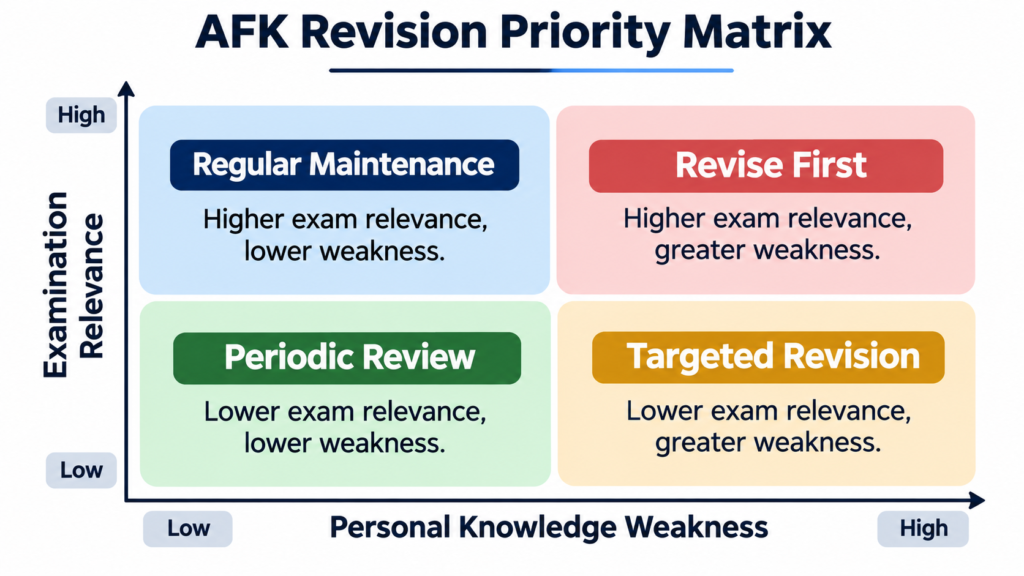
Your AFK revision priorities should reflect both the severity of your knowledge gaps and the relevance of the content to the examination.
Review the current AFK protocol through the NDEB examination resources to understand the official content areas before establishing priorities.
Use a Revision Priority Matrix
A revision priority matrix helps you determine which topics require immediate attention and which can be reviewed periodically.
| Knowledge level | Examination relevance | Revision priority |
|---|---|---|
| Weak | Higher | Immediate revision |
| Weak | Relatively lower | Targeted revision |
| Strong | Higher | Regular maintenance |
| Strong | Relatively lower | Periodic review |
Start with significant knowledge gaps in relevant examination content. Once your understanding improves, redirect additional revision time towards other unresolved weaknesses.
Remember that this matrix is an educational planning framework rather than an official NDEB assessment method. All examinable content deserves appropriate coverage.
Create an AFK Study Matrix to Organize Your Revision
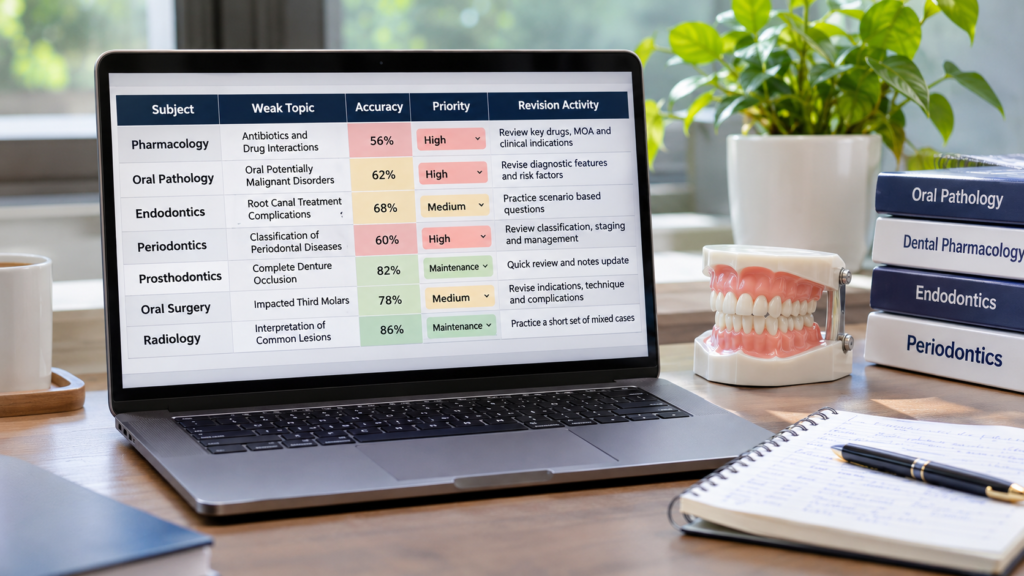
An AFK study matrix is a structured revision tool that records weak subjects, specific knowledge gaps, performance levels and corrective learning activities.
While a conventional timetable determines when you study, a study matrix helps you decide what to revise and why.
Example of an AFK Weak Subject Study Matrix
| Subject | Weak topic | Accuracy | Priority | Revision activity |
|---|---|---|---|---|
| Pharmacology | Drug interactions | 45% | High | Concept review and clinical MCQs |
| Oral pathology | Lesion differentiation | 55% | High | Comparison-based revision |
| Endodontics | Diagnostic interpretation | 70% | Medium | Case-based practice |
| Periodontics | Disease classification | 85% | Maintenance | Mixed recall practice |
These scores and priorities are illustrative. Individual revision priorities should reflect personal performance and examination relevance.
After each revision session, record your progress, remaining mistakes and next reassessment date.
You can integrate this matrix into your existing 12-week or 16-week AFK study schedule without having to redesign your entire preparation plan.
A Practical Seven-Day Study Plan for Weak AFK Subject Revision
Once you have identified your weak subjects and established revision priorities, organize your study sessions around specific learning objectives.
The following seven-day AFK revision plan focuses on correcting weaknesses, reinforcing understanding and measuring improvement.
| Day | Revision focus | Study activity | Expected objective |
|---|---|---|---|
| Day 1 | Weakness assessment | Review previous mistakes and update your study matrix | Identify priority topics |
| Day 2 | First weak subject | Rebuild difficult concepts and practise targeted MCQs | Address foundational gaps |
| Day 3 | Second weak subject | Review confusing concepts and clinical applications | Improve understanding |
| Day 4 | Delayed revision | Retest topics covered on Day 2 | Evaluate knowledge retention |
| Day 5 | Persistent weaknesses | Review recurring mistakes and adjust learning methods | Correct unresolved gaps |
| Day 6 | Mixed-subject revision | Practise weak and strong subjects together | Maintain broader knowledge |
| Day 7 | Performance assessment | Complete unfamiliar questions and update priorities | Plan the next revision cycle |
Repeat this cycle with updated priorities each week. Avoid automatically carrying the same subjects into the following week if your performance has improved.
How to Structure a 60-Minute Weak Subject Revision Session
| Duration | Revision activity |
|---|---|
| 10 minutes | Recall previously studied concepts without notes |
| 20 minutes | Review and correct specific knowledge gaps |
| 20 minutes | Complete targeted practice questions |
| 10 minutes | Analyse mistakes and update the study matrix |
A systematic review of retrieval and distributed practice in health professions education supports the educational benefits of recalling information from memory and distributing learning across multiple sessions.
Candidates balancing clinical responsibilities with examination preparation can incorporate these focused sessions into a 30-day AFK study timetable for working dentists to maintain a manageable routine.
How to Balance Weak and Strong Subjects During AFK Revision
Although weak subjects require additional attention, completely neglecting stronger areas can affect knowledge retention.
Consider the following starting distribution of your available revision time:
AFK Revision Time Allocation
60%High-priority weak topics
25%Moderately weak topics
15%Strong subject revision
Suggested revision distribution. Adjust according to individual performance and available study time.
These percentages are flexible recommendations rather than official examination requirements.
As your weaker subjects improve, gradually reduce intensive revision and move them into maintenance sessions. This allows you to address remaining knowledge gaps without losing previously acquired knowledge.
How to Track Improvement in Weak AFK Subjects
Effective revision should produce measurable improvements in understanding, recall and application.
After revising a difficult topic, practise unfamiliar questions rather than repeating the same MCQs. Reassess your understanding after several days to determine whether the knowledge has been retained.
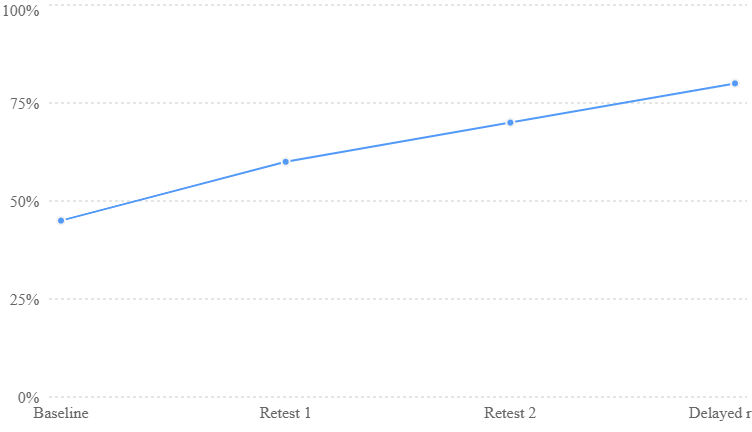
Illustrative example of pharmacology revision progress, not actual candidate results.
Track improvements in practice accuracy, confidence, independent reasoning and the frequency of recurring mistakes.
If a concept remains difficult despite repeated revision, consider discussing it with a dental educator or connecting with an AFK study partner. Explaining concepts to another candidate can help reveal gaps that are difficult to recognize during independent study.
Common Mistakes to Avoid During AFK Weak Subject Revision
Even a structured revision plan can become ineffective if it focuses on completing material rather than improving understanding.
Avoid these common revision mistakes:
- Spending excessive time revising familiar subjects.
- Ignoring questions answered correctly through guessing.
- Memorizing MCQ answers without understanding the reasoning.
- Revising an entire subject when only one topic requires attention.
- Neglecting stronger subjects completely.
- Failing to reassess weaknesses after revision.
- Keeping the same revision priorities despite measurable improvement.
During the final days before the AFK, concentrate on unresolved priority topics, recurring mistakes and previously revised concepts rather than attempting to cover large amounts of unfamiliar material.
Frequently Asked Questions
Which AFK subjects should I revise first?
Prioritize subjects where significant knowledge gaps overlap with relevant examination content. Your revision order should depend on individual performance and the current AFK blueprint rather than a universal subject ranking.
How do I identify weak AFK subjects after an unsuccessful examination attempt?
The NDEB does not provide a detailed subject-wise breakdown of AFK examination results. Use independent diagnostic assessments, mock examinations and previous practice records to identify topics requiring further revision.
What is an AFK study matrix?
An AFK study matrix is a structured worksheet used to record weak subjects, specific knowledge gaps, revision priorities, corrective activities and reassessment results.
Should I revise weak AFK subjects every day?
High-priority weak subjects may benefit from frequent, focused revision. However, distributing revision across multiple sessions and allowing time for delayed reassessment can help evaluate knowledge retention.
When should I stop intensive revision of a weak subject?
Reduce intensive revision when you can consistently recall the relevant concepts, explain your reasoning and answer unfamiliar questions correctly across multiple practice sessions.
Final Thoughts: Make Your AFK Revision More Purposeful
Smarter AFK revision begins with understanding your weaknesses rather than repeatedly studying the entire syllabus. By identifying knowledge gaps, establishing revision priorities and maintaining an AFK study matrix, you can direct your study time towards areas that require meaningful improvement.
Regular reassessment will help you determine whether your revision strategies are working and where further attention is needed. Explore more AFK preparation guides and study resources at DentalHeight to strengthen your dental knowledge and develop a structured approach to examination revision.
{ “@context”: “https://schema.org”, “@type”: “FAQPage”, “mainEntity”: [{ “@type”: “Question”, “name”: “Which AFK subjects should I revise first?”, “acceptedAnswer”: { “@type”: “Answer”, “text”: “Prioritize subjects where significant knowledge gaps overlap with relevant examination content. Your revision order should depend on individual performance and the current AFK blueprint rather than a universal subject ranking.” } },{ “@type”: “Question”, “name”: “How do I identify weak AFK subjects after an unsuccessful examination attempt?”, “acceptedAnswer”: { “@type”: “Answer”, “text”: “The NDEB does not provide a detailed subject-wise breakdown of AFK examination results. Use independent diagnostic assessments, mock examinations and previous practice records to identify topics requiring further revision.” } },{ “@type”: “Question”, “name”: “What is an AFK study matrix?”, “acceptedAnswer”: { “@type”: “Answer”, “text”: “An AFK study matrix is a structured worksheet used to record weak subjects, specific knowledge gaps, revision priorities, corrective activities and reassessment results.” } },{ “@type”: “Question”, “name”: “Should I revise weak AFK subjects every day?”, “acceptedAnswer”: { “@type”: “Answer”, “text”: “An AFK study matrix is a structured worksheet used to record weak subjects, specific knowledge gaps, revision priorities, corrective activities and reassessment results.” } },{ “@type”: “Question”, “name”: “When should I stop intensive revision of a weak subject?”, “acceptedAnswer”: { “@type”: “Answer”, “text”: “Reduce intensive revision when you can consistently recall the relevant concepts, explain your reasoning and answer unfamiliar questions correctly across multiple practice sessions.” } }] }