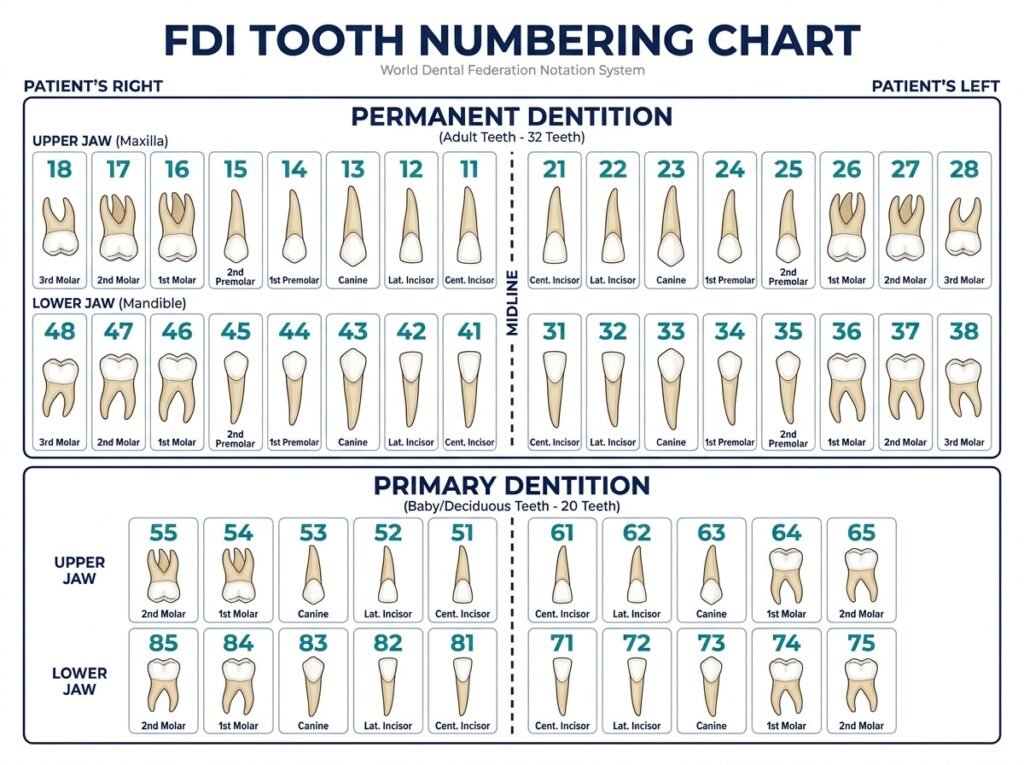
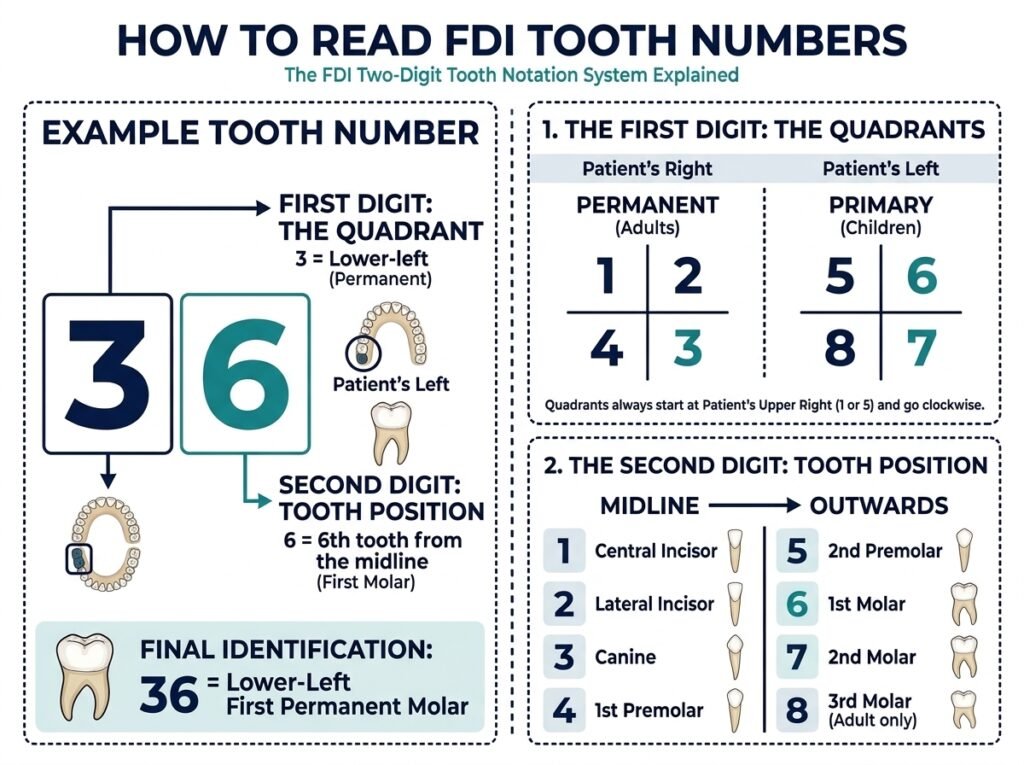
The FDI tooth numbering system is an internationally recognized method used by dental professionals to identify individual teeth accurately. It uses a simple two-digit structure in which the first digit represents the dental quadrant and dentition, while the second identifies the tooth’s position from the midline.
Understanding this system is essential for dental charting, clinical documentation, radiographic interpretation, and dental anatomy studies. Whether you are learning permanent or primary dentition, this guide explains the FDI tooth numbering system with easy-to-follow charts, practical examples, and comparisons with other commonly used numbering methods.
What Is the FDI Tooth Numbering System?
The FDI tooth numbering system, also known as the FDI Two-Digit Notation System, is an internationally standardized method of identifying individual teeth. It follows the principles established in ISO 3950, which provides a consistent approach to designating teeth and areas of the oral cavity.
Unlike numbering systems that assign a continuous number to every tooth, FDI notation divides the mouth into four quadrants. Each tooth receives a unique two-digit number representing its location and position.
The system covers two types of dentition:
-
- Permanent dentition: Contains 32 teeth, identified using quadrant numbers 1–4.
-
- Primary dentition: Contains 20 teeth, identified using quadrant numbers 5–8.
How Does the Two-Digit FDI System Work?
Every FDI tooth number consists of two digits, and each digit has a specific meaning:
-
- First digit: Identifies the dental quadrant and whether the tooth belongs to permanent or primary dentition.
-
- Second digit: Identifies the tooth’s position, starting from the midline and moving toward the back of the mouth.
For example, consider tooth number 36:
-
- The first digit (3) represents the lower-left permanent quadrant.
-
- The second digit (6) represents the first molar.
Therefore, tooth 36 is the lower-left first permanent molar.
Important: FDI tooth numbers should not be interpreted as ordinary mathematical numbers. Each digit represents a separate anatomical detail.
FDI Permanent Teeth Chart: Understanding All 32 Teeth
Permanent dentition consists of 32 teeth distributed equally across the maxillary (upper) and mandibular (lower) arches. Each quadrant contains eight teeth, including incisors, a canine, premolars, and molars.
1. Permanent Dentition Quadrants
The FDI permanent teeth chart uses four quadrant numbers to identify the location of each tooth.
| Quadrant | Location | Tooth numbers |
|---|---|---|
| 1 | Upper right | 11–18 |
| 2 | Upper left | 21–28 |
| 3 | Lower left | 31–38 |
| 4 | Lower right | 41–48 |
Quadrants are identified from the patient’s perspective rather than the observer’s. This distinction is particularly important when interpreting dental diagrams, radiographs, and clinical records.
2. Permanent Tooth Positions and Their Numbers
The second digit identifies the specific tooth within its quadrant. Numbering begins at the central incisor and moves posteriorly toward the third molar.
| Second digit | Tooth type |
|---|---|
| 1 | Central incisor |
| 2 | Lateral incisor |
| 3 | Canine |
| 4 | First premolar |
| 5 | Second premolar |
| 6 | First molar |
| 7 | Second molar |
| 8 | Third molar |
3. Examples of Permanent Tooth Identification
The following examples demonstrate how to interpret common FDI tooth numbers:
-
- 11: Upper-right central incisor.
-
- 13: Upper-right canine.
-
- 16: Upper-right first molar.
-
- 21: Upper-left central incisor.
-
- 24: Upper-left first premolar.
-
- 26: Upper-left first molar.
-
- 36: Lower-left first molar.
-
- 38: Lower-left third molar.
-
- 46: Lower-right first molar.
-
- 48: Lower-right third molar.
Once you understand the quadrant numbers and tooth positions, identifying other permanent teeth becomes much easier.
FDI Primary Teeth Numbering: Complete Guide to All 20 Teeth
Primary dentition, also called deciduous or baby teeth, consists of 20 teeth. Each quadrant contains five teeth, compared with eight teeth in permanent dentition.
The FDI primary teeth numbering system uses quadrant numbers 5–8. The second digit follows the same positioning principle as permanent dentition, but numbering stops at 5 because primary teeth do not include premolars or third molars.
1. Primary Dentition Quadrants
The four primary dentition quadrants are identified as follows:
| Quadrant | Location | Tooth numbers |
|---|---|---|
| 5 | Upper right | 51–55 |
| 6 | Upper left | 61–65 |
| 7 | Lower left | 71–75 |
| 8 | Lower right | 81–85 |
2. Primary Tooth Positions
The second digit indicates the tooth’s position within the primary quadrant.
| Second digit | Primary tooth type |
|---|---|
| 1 | Central incisor |
| 2 | Lateral incisor |
| 3 | Canine |
| 4 | First molar |
| 5 | Second molar |
Unlike permanent dentition, primary dentition does not contain premolars. Instead, the first and second primary molars occupy the posterior positions.
3. Examples of Primary Tooth Identification
Here are some common examples to help you understand primary tooth numbering:
-
- 51: Upper-right central incisor.
-
- 54: Upper-right first primary molar.
-
- 55: Upper-right second primary molar.
-
- 61: Upper-left central incisor.
-
- 65: Upper-left second primary molar.
-
- 73: Lower-left canine.
-
- 81: Lower-right central incisor.
-
- 85: Lower-right second primary molar.
Understanding these numbers is especially useful when studying pediatric dental anatomy and identifying teeth during the transition between primary and permanent dentition.
How to Read and Interpret FDI Tooth Numbers
Identifying a tooth using FDI notation becomes straightforward when you follow a consistent approach.
Use these four steps:
-
- Identify the dentition: Determine whether the tooth belongs to permanent or primary dentition.
-
- Check the first digit: Identify the correct quadrant using the patient’s right and left sides.
-
- Read the second digit: Determine the tooth’s position, starting from the midline.
-
- Confirm the tooth type: Match the position with the corresponding anatomical tooth.
Practical Example: Identifying Tooth 26
Let’s break down tooth number 26:
-
- First digit (2): Upper-left permanent quadrant.
-
- Second digit (6): First molar.
-
- Final identification: Upper-left first permanent molar.
This approach applies to every valid individual tooth number in both permanent and primary dentition.
FDI vs. Universal vs. Palmer Tooth Numbering Systems
Dental professionals may encounter different tooth numbering systems in clinical records, educational materials, and international dental literature. Understanding how these systems differ helps prevent confusion during tooth identification.
1. Universal Tooth Numbering System
The Universal tooth numbering system is commonly used in the United States.
Permanent teeth are numbered from 1 to 32, beginning with the upper-right third molar and continuing around the dental arches.
Primary teeth are identified using letters A–T.
2. Palmer Tooth Notation System
Palmer notation divides the mouth into four quadrants. Each tooth is identified using a quadrant symbol combined with a number or letter.
Permanent teeth are numbered 1–8, while primary teeth use letters A–E.
3. Comparison of the Three Numbering Systems
The following table highlights the main differences between FDI, Universal, and Palmer notation.
| Feature | FDI | Universal | Palmer |
|---|---|---|---|
| Permanent teeth | 11–48 | 1–32 | 1–8 per quadrant |
| Primary teeth | 51–85 | A–T | A–E per quadrant |
| Quadrant identification | First digit | Continuous sequence | Quadrant symbol |
| Format | Two digits | Number or letter | Symbol and number/letter |
For example, the lower-left first permanent molar is identified differently in each system:
-
- FDI: 36
-
- Universal: 19
-
- Palmer: Lower-left quadrant, position 6
Recognizing these differences is useful when interpreting international dental literature and reviewing clinical records that follow different notation systems.
Tooth Numbering in Mixed Dentition
Mixed dentition refers to the developmental stage when primary and permanent teeth are present in the mouth simultaneously. It usually begins around six years of age, when the first permanent molars and permanent incisors start erupting.
The FDI system makes tooth identification easier during this stage because permanent and primary teeth have different first-digit quadrant codes.
For example, a child may have the following teeth present at the same time:
-
- 55: Upper-right second primary molar.
-
- 16: Upper-right first permanent molar.
When studying mixed dentition, focus on identifying the actual tooth rather than assuming its identity based only on the patient’s age.
Clinical Applications of the FDI Tooth Numbering System
Accurate tooth identification plays an important role in several areas of dentistry. The FDI system provides a standardized method of documenting findings and communicating treatment information.
Its major clinical applications include:
-
- Dental charting: Identifies individual teeth in patient records, examination findings, and treatment plans.
-
- Dental radiographs: Helps locate specific teeth when reviewing intraoral and panoramic images.
-
- Restorative dentistry: Identifies teeth requiring fillings, crowns, and other restorative procedures.
-
- Endodontics: Documents the exact tooth receiving root canal treatment.
-
- Periodontics: Supports accurate communication about periodontal findings and treatment locations.
-
- Pediatric dentistry: Distinguishes primary teeth from permanent teeth during different developmental stages.
Using standardized notation reduces identification errors and improves communication between dental professionals.
Common FDI Tooth Numbering Mistakes to Avoid
Although the FDI system follows a straightforward structure, students and dental professionals can sometimes confuse quadrant orientation or tooth positions.
Here are six common mistakes to watch for:
1. Confusing the patient’s right and left sides
Always identify quadrants from the patient’s perspective, not your own. This is particularly important when reading dental charts and radiographs.
2. Mixing permanent and primary quadrants
Remember that permanent dentition uses quadrant numbers 1–4, while primary dentition uses 5–8.
3. Reading the two digits as one number
Tooth 36 represents quadrant 3 and position 6. It does not simply mean the number thirty-six.
4. Confusing premolars and molars
In permanent dentition, positions 4 and 5 represent premolars, while positions 6–8 represent molars.
5. Using invalid primary tooth positions
Primary dentition only uses positions 1–5 within each quadrant. It does not contain premolars or third molars.
6. Mixing different numbering systems
Before interpreting a dental chart, confirm whether it uses FDI, Universal, or Palmer notation.
How to Study FDI Tooth Numbering for the NDEB AFK
Learning the FDI tooth numbering system is a useful part of dental anatomy AFK preparation. It strengthens anatomical identification skills and helps candidates become more familiar with clinical terminology.
The following study methods can make learning tooth numbering easier:
-
- Memorize the four permanent and four primary quadrants.
-
- Learn the tooth sequence from the central incisor to the posterior molars.
-
- Practise identifying teeth using blank dental arch diagrams.
-
- Compare permanent and primary dentition numbering charts.
-
- Review clinical examples and identify the tooth before reading the explanation.
-
- Use practice questions to test recall and correct identification mistakes.
The NDEB describes the AFK as an assessment of biomedical science and applied clinical science knowledge. Candidates should consult the official NDEB AFK examination information for the current examination format and preparation requirements.
This guide is an independent educational resource, not an official NDEB publication or a statement that FDI numbering is a separately weighted examination topic.
For a broader preparation strategy, explore AFK preparation guides and its 30-Day AFK Study Timetable for Working Dentists.
Frequently Asked Questions About FDI Tooth Numbering
1. What is the FDI tooth numbering system?
The FDI tooth numbering system is an internationally recognized two-digit method of identifying individual teeth. The first digit indicates the quadrant and dentition, while the second identifies the tooth’s position.
2. How many teeth are included in the FDI permanent teeth chart?
Permanent dentition contains 32 teeth, divided into four quadrants with eight teeth in each quadrant.
3. How many teeth are included in FDI primary teeth numbering?
Primary dentition contains 20 teeth, divided into four quadrants with five teeth in each quadrant.
4. What does tooth number 36 mean?
Tooth 36 represents the lower-left first permanent molar. The first digit identifies quadrant 3, and the second digit identifies position 6.
5. What does tooth number 85 represent?
Tooth 85 represents the lower-right second primary molar.
6. How are wisdom teeth numbered in the FDI system?
Wisdom teeth are third molars and occupy position 8 in each permanent quadrant. Their FDI numbers are 18, 28, 38, and 48.
7. What is the difference between FDI and Universal numbering?
The FDI system uses two digits to identify the quadrant and tooth position. The Universal system uses numbers 1–32 for permanent teeth and letters A–T for primary teeth.
8. How can I memorize FDI tooth numbers?
Start by memorizing the quadrant numbers, then learn the tooth positions from the midline. Practising with labelled and blank dental charts can improve identification and recall.
Conclusion
The FDI tooth numbering system provides a standardized and consistent method of identifying permanent and primary teeth through a simple two-digit structure. Understanding quadrant numbers, tooth positions, and differences between dentitions makes dental chart interpretation easier and supports accurate clinical communication.
For internationally trained dentists, mastering these fundamentals is a valuable part of dental anatomy and tooth identification. Regular practice with permanent and primary dentition charts, clinical examples, and self-assessment questions can strengthen this knowledge as part of broader NDEB AFK preparation.
Keep practising, focus on anatomical understanding, and use FDI numbering charts as a reference until tooth identification becomes second nature.