If your teeth sets toothache that lingers after they stop drinking. This pain starts on its own. You reproduce it with a cold test, then find that the same tooth is tender to percussion. The radiograph shows no obvious change around the root tip. What would you write in the chart?
The lingering cold response and spontaneous pain support symptomatic irreversible pulpitis. The percussion tenderness supports symptomatic apical periodontitis, even though there is no visible radiolucency. It’s easy to stop once you’ve named the pulp condition. The second diagnosis explains a finding the first one leaves unanswered. www.aae.org
If you’re preparing for Canada’s Assessment of Fundamental Knowledge (AFK), work through each case by asking what the findings tell you about the pulp and what they tell you about the tissues around the root. This DentalHeight guide uses the published AAE classifications, walks through the tests, and gives you original questions to practise that reasoning. Find the current exam format and protocol on the NDEB’s official AFK page. ndeb-bned.ca
What is the difference between pulpal and periapical diagnosis?
A pulpal diagnosis describes the clinical condition of the pulp or records the tooth’s previous endodontic treatment. A periapical diagnosis, also called an apical diagnosis, describes the tissues around the root tip. The two can change independently. A tooth with inflamed pulp may still have normal apical tissues. A tooth that had root canal treatment years ago may become tender on biting and need a new assessment of its apical status. www.aae.org
Start by identifying the tooth. In a question that mentions 36 and 37, keep track of which molar reproduced the complaint and which served as a control. It takes only one misplaced test result to change the answer. If the numbering slows you down, review DentalHeight’s FDI tooth numbering guide. www.dentalheight.com
AAE classification of pulpal and periapical diagnoses
The American Association of Endodontists (AAE) published its consensus terminology in 2009. The two charts below use those categories. Read the clinical clues as patterns you can recognize in a case. Individual teeth can respond differently depending on their history and the condition being assessed. www.aae.org
Pulpal diagnosis chart
| AAE pulpal diagnosis | What you might find |
|---|---|
| Normal pulp | The patient reports no pulpal symptoms, and the tooth responds to sensibility testing much like healthy control teeth. |
| Reversible pulpitis | Cold or sweets provoke discomfort that settles soon after the stimulus is removed. The findings suggest the pulp can recover once the cause is addressed. |
| Symptomatic irreversible pulpitis | The pulp is vital and inflamed. Lingering thermal pain, spontaneous episodes, or pain felt in another area may support the diagnosis. |
| Asymptomatic irreversible pulpitis | The patient reports no pain, but clinical findings support the diagnosis, as may occur with deep caries and pulpal involvement. The tooth can still respond to sensibility testing. |
| Pulp necrosis | The pulp has died and usually gives no sensibility response. Compare with controls and look for other findings before drawing a conclusion from an absent response. |
| Previously treated | The root canals have been obturated. Use the treatment history or radiograph to identify this category. |
| Previously initiated therapy | Endodontic treatment was started, for example with a pulpotomy or pulpectomy. The sensibility response can vary with the extent of treatment. |
A useful distinction between reversible and symptomatic irreversible pulpitis is what happens after the cold stimulus stops. A sharp response that settles promptly tells a different story from pain that lingers and also wakes the patient at night. The intensity of the response alone is less useful. Treatment selection requires a fuller assessment, and vital pulp therapy may be an option in selected cases. See the European Society of Endodontology S3 clinical practice guideline. www.aae.org
Periapical diagnosis chart
| AAE apical diagnosis | What you might find |
|---|---|
| Normal apical tissues | No tenderness to percussion or palpation. The periodontal ligament space looks uniform, and the lamina dura is intact. |
| Symptomatic apical periodontitis | Biting, percussion, or palpation elicits pain consistent with apical inflammation. The radiograph may or may not show a radiolucency. |
| Asymptomatic apical periodontitis | A radiolucency of pulpal origin is present around the apex without clinical symptoms attributable to the lesion. |
| Acute apical abscess | Pain and swelling develop rapidly, with marked tenderness and pus formation. Early imaging may show little or no bone change. |
| Chronic apical abscess | The patient may have little discomfort and notice intermittent discharge through a sinus tract. |
| Condensing osteitis | A diffuse radiopacity around the apex reflects a local bone response to an inflammatory stimulus. Interpret it alongside the tooth’s clinical findings. |
When choosing between an acute and chronic apical abscess, pay attention to the patient’s account. A painful swelling that developed quickly points toward an acute presentation. A patient who mentions that a small gum opening repeatedly drains, then settles, gives you a different clue. The size of the lesion on a radiograph tells you less about that distinction than the history and examination. www.aae.org
How to interpret endodontic diagnostic tests
Start with what the patient feels
Ask when the pain began, what triggers it, how long it lasts, and whether it happens without a trigger. Clarify what the patient means by “pain when eating.” They may be describing a response to cold food, pressure on the tooth, or pain when they release their bite. Each answer directs your attention to different findings. Ask about recent trauma, restorations, and previous endodontic treatment before you interpret the examination. www.aae.org
Compare pulp sensibility with suitable controls
Cold testing and the electric pulp test (EPT) assess whether the pulp’s sensory nerves respond to a stimulus. Pulp vitality refers to the blood supply. That distinction matters when a tooth has been recently traumatized. It may temporarily fail to respond to cold, so an absent response early after injury is insufficient on its own to establish necrosis. Immature roots, calcification, and restorations can also complicate interpretation. www.aae.org
Test suitable control teeth to establish what an ordinary response feels like for that patient. Record whether there was a response, whether it persisted, and whether it reproduced the pain the patient came in for. Those details are easier to interpret later than a chart entry that simply says “positive.” www.aae.org
Examine the apical tissues and review the radiograph
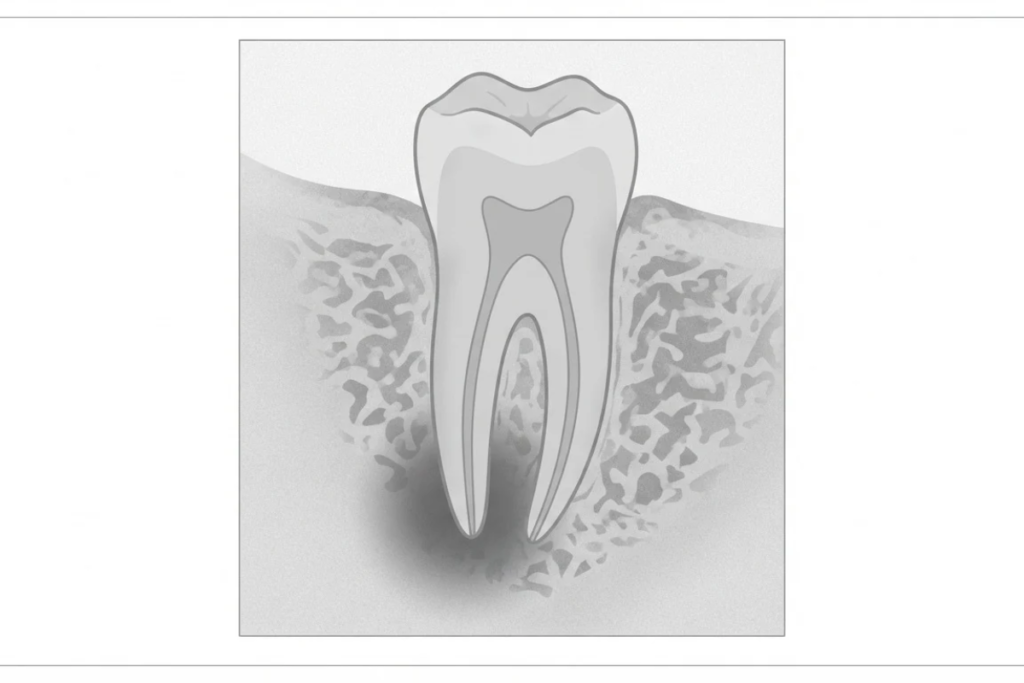
Percussion helps identify tenderness in the supporting tissues. Palpation checks for tenderness over the root apex. A bite test and focused periodontal probing can add information when a crack or periodontal source is suspected. On a periapical radiograph, examine the periodontal ligament space, lamina dura, and surrounding bone. Cone-beam computed tomography (CBCT) is a selective adjunct when the clinical examination and conventional imaging leave a question that could change management. See the AAE Endodontic Diagnosis clinical guide for examination methods and worked examples. www.aae.org
Differential diagnosis when the findings disagree
Suppose you see a radiolucency near the root of a tooth that responds much like its controls. Before assigning a diagnosis, ask whether the lesion actually originates from that tooth. Check the adjacent teeth, the location of the radiolucency, and whether an anatomical structure could be superimposed on the image. Even when the lesion appears to be of endodontic origin, a routine radiograph cannot reliably distinguish a radicular cyst from a granuloma. www.aae.org
| Finding | What to investigate next |
|---|---|
| Pain on biting or release that localizes to one cusp | Consider a cracked tooth. Compare individual cusps and check for an isolated probing defect. |
| Swelling next to a deep periodontal pocket | Consider a periodontal source. Relate the swelling and probing findings to the pulp tests and imaging. |
| An incidental radiopacity around the apex | Consider condensing osteitis, idiopathic osteosclerosis, or cemento-osseous dysplasia. Look at the distribution of the opacity and the condition of the associated teeth. |
| The suspected tooth fails to reproduce the presenting pain | Reassess neighbouring teeth. Consider referred pain or a non-odontogenic source, including sinus-related symptoms if the history fits. |
If the findings still conflict, record what remains uncertain. Reassessment or referral may be appropriate before committing to irreversible treatment. www.aae.org
What is the new endodontic diagnosis classification?
Terminology status checked 23 November 2026. The AAE and the European Society of Endodontology (ESE) are working together to update endodontic diagnostic terminology. The AAE presents the available framework as a proposal, with one draft table for pulpal and pulp-space diagnoses and another for periapical diagnoses. Examples include mild pulpitis, severe pulpitis, and healing apical tissue. These categories have draft criteria of their own. If you encounter one in your reading, check the definition before mapping it to a case. The AAE–ESE terminology project page includes both tables and the stakeholder feedback summary. www.aae.org
AFK-style practice questions on pulpal and periapical diagnosis
Choose the single best answer for each original DentalHeight practice question. Before looking at the key, identify the finding that makes your choice stronger than the closest alternative.
1. A sharp response to cold
A mandibular molar with caries responds more strongly to cold than the control tooth. The pain stops promptly after the stimulus is removed. There is no spontaneous pain, and the apical examination is normal.
- A. Symptomatic irreversible pulpitis + normal apical tissues
- B. Reversible pulpitis + normal apical tissues
- C. Reversible pulpitis + symptomatic apical periodontitis
- D. Pulp necrosis + normal apical tissues
2. An incidental radiolucency
An untreated incisor gives no response on repeat cold and electric pulp testing. The controls respond normally. Clinical findings support an apical lesion of pulpal origin. The tooth is comfortable on biting and shows no swelling or drainage.
- A. Pulp necrosis + chronic apical abscess
- B. Normal pulp + normal apical tissues
- C. Pulp necrosis + asymptomatic apical periodontitis
- D. Pulp necrosis + symptomatic apical periodontitis
3. Swelling that developed overnight
A patient reports rapidly developing pain and swelling around an untreated molar. Examination reveals marked tenderness and purulence. The pulp findings are consistent with necrosis.
- A. Pulp necrosis + acute apical abscess
- B. Pulp necrosis + chronic apical abscess
- C. Pulp necrosis + symptomatic apical periodontitis
- D. Symptomatic irreversible pulpitis + normal apical tissues
4. Biting pain in a root-filled tooth
A premolar with obturated canals is painful on biting and reproducibly tender to percussion. There is no swelling or drainage.
- A. Previously initiated therapy + symptomatic apical periodontitis
- B. Previously treated + chronic apical abscess
- C. Previously treated + normal apical tissues
- D. Previously treated + symptomatic apical periodontitis
Answer key
| Question | Answer | Reasoning |
|---|---|---|
| 1 | B | The response is exaggerated but short-lived. Its duration and the lack of spontaneous pain favour reversible pulpitis, with normal apical findings. |
| 2 | C | Repeat sensibility testing and the lesion support pulp necrosis. The absence of symptoms attributable to the apical lesion supports asymptomatic apical periodontitis. |
| 3 | A | The combination of rapid onset, swelling, and purulence supports an acute apical abscess. |
| 4 | D | The filled canals establish the treatment designation. The biting pain and percussion tenderness support the current apical diagnosis. |
The answers use the published AAE consensus terminology PDF, which includes all seven pulpal and six apical categories in one reference. www.aae.org
Frequently asked questions
Is there a fixed cold-test duration that proves irreversible pulpitis?
There is no universal time cutoff that establishes the diagnosis. A lingering response carries more weight when it reproduces the patient’s complaint and fits the history and clinical findings. Comparing the suspect tooth with controls helps you judge what is unusual for that patient.
Why can a chronic apical abscess cause little discomfort?
A sinus tract gives the infection a route to drain, which can limit pressure buildup. The patient may report recurring discharge and very little pain. If several teeth are near the opening, tracing the tract when clinically indicated can help identify its source.
Can a tooth with a normal cold response still be tender to percussion?
Yes. The two tests assess different tissues. A control-like cold response gives information about pulp sensibility, while percussion tenderness calls for an assessment of the supporting tissues and possible causes such as a recent restoration, a crack, or periodontal involvement.
Put both diagnoses into your next AFK review
After a practice question, write one line for the pulp and one for the apical tissues. Beside each, note the finding that earned it. If you chose the wrong answer, write down the clue you missed and try the case again a few days later. DentalHeight’s 12-week and 16-week AFK study schedules show how to build that kind of spaced practice into a wider revision plan.
{ “@context”: “https://schema.org”, “@type”: “FAQPage”, “mainEntity”: [{ “@type”: “Question”, “name”: “Is there a fixed cold-test duration that proves irreversible pulpitis?”, “acceptedAnswer”: { “@type”: “Answer”, “text”: “There is no universal time cutoff that establishes the diagnosis. A lingering response carries more weight when it reproduces the patient’s complaint and fits the history and clinical findings. Comparing the suspect tooth with controls helps you judge what is unusual for that patient.” } },{ “@type”: “Question”, “name”: “Why can a chronic apical abscess cause little discomfort?”, “acceptedAnswer”: { “@type”: “Answer”, “text”: “A sinus tract gives the infection a route to drain, which can limit pressure buildup. The patient may report recurring discharge and very little pain. If several teeth are near the opening, tracing the tract when clinically indicated can help identify its source.” } },{ “@type”: “Question”, “name”: “Can a tooth with a normal cold response still be tender to percussion?”, “acceptedAnswer”: { “@type”: “Answer”, “text”: “Yes. The two tests assess different tissues. A control-like cold response gives information about pulp sensibility, while percussion tenderness calls for an assessment of the supporting tissues and possible causes such as a recent restoration, a crack, or periodontal involvement.” } }] }