For internationally trained dentists planning to practise in Canada, understanding the NDEB Equivalency Process is an important part of preparing for professional registration. One of the earliest milestones in this journey is the Assessment of Fundamental Knowledge (AFK), which evaluates the scientific knowledge needed to progress toward later clinical examinations.
However, passing the AFK does not automatically qualify a dentist to practise in Canada. It is the first examination in a broader pathway involving clinical judgement, practical competence, national certification and provincial licensure.
The AFK is the first examination in the NDEB Equivalency Process for graduates of non-accredited dental programs. Candidates must pass it before progressing to the Assessment of Clinical Judgement (ACJ), followed by the National Dental Examination of Clinical Competence (NDECC). Successful completion of the equivalency examinations makes candidates eligible for the separate NDEB Certification Process.
This guide explains where the AFK fits in the NDEB licensure pathway, what candidates need before taking it, and how it connects to the examinations and requirements that follow.
What Is the NDEB Equivalency Process?

The National Dental Examining Board of Canada (NDEB) administers the Equivalency Process for eligible graduates of non-accredited dental programs who want to pursue certification as general dentists in Canada.
In Canada, dental program accreditation is determined by the Commission on Dental Accreditation of Canada (CDAC). Graduates whose dental qualifications are not recognized through the applicable accreditation arrangements generally need to complete an accepted entry-to-practice pathway before becoming eligible for national certification.
The NDEB Equivalency Process consists of three examinations:
- Assessment of Fundamental Knowledge (AFK): Evaluates biomedical and applied clinical science knowledge.
- Assessment of Clinical Judgement (ACJ): Assesses diagnosis, treatment planning, clinical decisions and radiographic interpretation.
- National Dental Examination of Clinical Competence (NDECC): Evaluates clinical competence through simulated clinical requirements and situational judgement.
Together, these assessments provide a route for eligible graduates of non-accredited programs to demonstrate the knowledge, judgement and skills expected for progression to certification.
For a broader explanation of the overall journey, see DentalHeight’s guide to becoming a licensed dentist in Canada.
Where Does the AFK Fit in the NDEB Licensure Pathway?
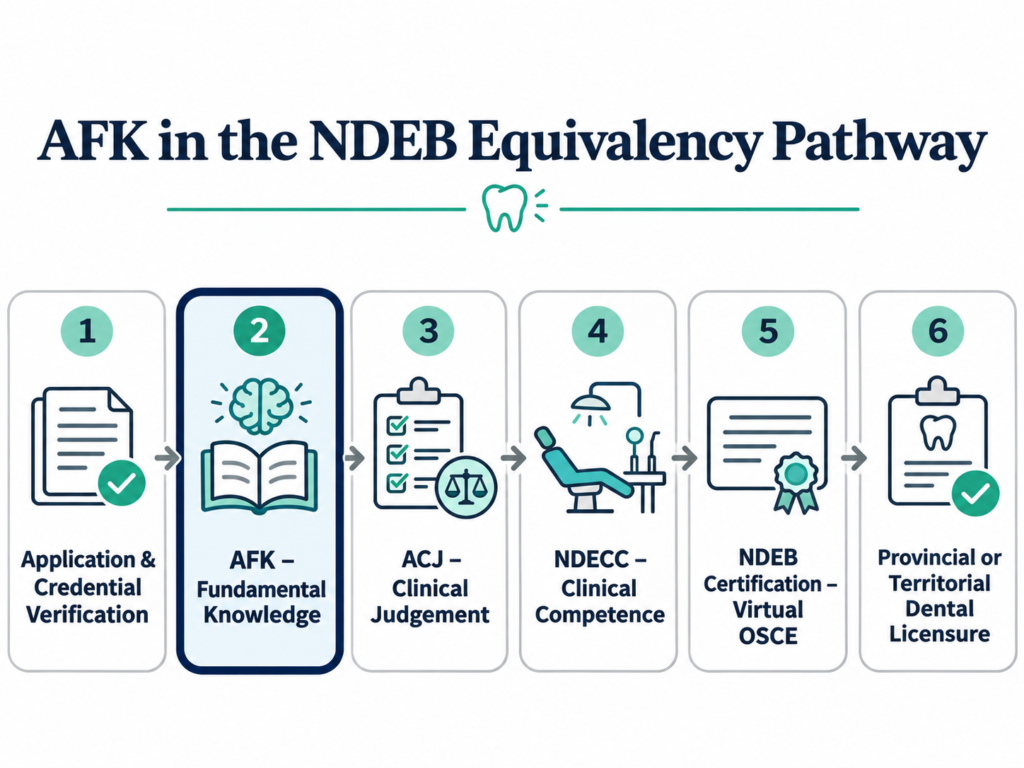
The AFK occupies a specific position in the NDEB pathway: it comes after application and credential approval but before the clinical judgement and clinical competence examinations.
It serves as the initial knowledge assessment rather than a final professional licensing test.
The NDEB Pathway From AFK to Licensure
| Stage | Assessment or requirement | Purpose |
|---|---|---|
| 1 | Application and credential verification | Establish eligibility for the Equivalency Process |
| 2 | AFK | Assess fundamental dental knowledge |
| 3 | ACJ | Evaluate clinical judgement and diagnostic decisions |
| 4 | NDECC | Assess practical clinical competence |
| 5 | NDEB Certification Process | Complete national certification requirements |
| 6 | Provincial or territorial licensure | Obtain authorization to practise dentistry |
This sequence shows why AFK preparation should be considered part of a longer professional plan.
The AFK does not assess candidates through practical patient-treatment procedures. Instead, it tests knowledge that supports clinical reasoning and professional decision-making.
Candidates who understand this progression can plan their preparation around the different demands of each stage rather than treating all NDEB examinations as interchangeable.
The official NDEB entry-to-practice guidance explains the available routes for graduates of non-accredited dental programs.
What Must Candidates Complete Before Taking the AFK?
Before registering for the AFK, candidates must apply to the NDEB Equivalency Process and have their credentials approved.
Application and Credential Verification
The application generally involves reviewing the relevant documentation requirements, creating an NDEBConnect profile and submitting the requested educational and identification records.
The NDEB verifies the authenticity of submitted documents and confirms that the applicant meets the eligibility requirements.
Candidates should pay particular attention to institution-issued documents, identity records and submission instructions. Incorrect or incomplete documentation can delay approval.
Once the NDEB approves the application, the candidate becomes eligible to register for the AFK when registration is available.
The official NDEB application instructions provide the current requirements.
Is Canadian Residency Required?
Canadian citizenship or permanent residency is not required to apply to the Equivalency Process or participate in its examinations.
However, candidates taking examinations outside their country of residence should independently check applicable travel and immigration requirements.
It is also important to distinguish AFK eligibility from the additional requirements that may apply when seeking a provincial dental licence.
For related information, DentalHeight explains IELTS scores and AFK applications for internationally trained dentists.
What Does the AFK Examination Assess?
The Assessment of Fundamental Knowledge evaluates the biomedical and applied clinical science knowledge relevant to general dentistry.
It helps establish whether candidates have the theoretical foundation necessary for the clinical decision-making assessments that follow.
The examination draws on dental education knowledge and its application to clinical situations. Candidates therefore need more than isolated fact memorization; they must be able to understand concepts and apply them when interpreting questions.
AFK Examination Format and Passing Score
According to the official NDEB AFK examination page, the examination has the following structure:
- 200 single-answer multiple-choice questions
- Two examination parts, each lasting two hours
- Electronic delivery at Prometric centres or booklet delivery at designated locations
- A passing test-equated, re-scaled score of 75 or higher
- A maximum of three attempts
An important distinction concerns scoring.
The passing score of 75 is a standardized, test-equated score. It should not be interpreted as a requirement to answer exactly 75% of the questions correctly.
The NDEB uses test equating to maintain consistency across different examination versions.
Candidates should read the latest AFK protocol before the examination, since it contains the applicable instructions and examination procedures.
What Happens After Passing the AFK?
Passing the AFK establishes eligibility to progress to the next examination in the NDEB Equivalency Process.
The next stage is the Assessment of Clinical Judgement (ACJ).
Moving From AFK to ACJ
While the AFK emphasizes foundational knowledge, the ACJ evaluates the ability to interpret clinical information and make appropriate decisions.
It assesses areas such as diagnosis, treatment planning, clinical decision-making and interpretation of dental radiographs.
This difference matters when planning preparation.
A candidate who has successfully prepared for the AFK should adapt their study approach for ACJ by paying greater attention to clinical cases, decision-making and interpretation of diagnostic findings.
The NDEB ACJ examination guidance confirms that candidates become eligible to register after passing the AFK.
Progressing From ACJ to NDECC
After successfully completing ACJ, candidates progress toward the NDECC, the final examination in the Equivalency Process.
NDECC assesses clinical competence through simulated clinical procedures and situational judgement scenarios.
Unlike the AFK, which primarily tests knowledge through written questions, NDECC requires candidates to demonstrate competencies relevant to performing clinical dentistry.
This creates a progression from understanding dental science to applying professional judgement and demonstrating practical competence.
How Does AFK Connect to NDEB Certification and Dental Licensure?
The Equivalency Process and the Certification Process are two distinct stages.
Passing AFK, ACJ and NDECC completes the examination requirements of the equivalency route. Candidates can then progress to the NDEB Certification Process.
Under the current pathway, eligible candidates must complete the Virtual OSCE certification examination and meet the applicable certification requirements.
NDEB certification is an important professional credential, but it does not independently authorize dental practice in every Canadian jurisdiction.
Dental licensure is issued by provincial or territorial dental regulatory authorities, not directly by the NDEB.
Depending on the jurisdiction, applicants may need to provide documentation, demonstrate language proficiency, complete jurisprudence requirements or satisfy other regulatory conditions.
Candidates should therefore consult the dental regulatory authority in the province or territory where they intend to practise.
The NDEB’s official guide to becoming a dentist in Canada provides further guidance on the distinction between national certification and professional registration.
Can International Dentists Follow an Alternative Pathway?
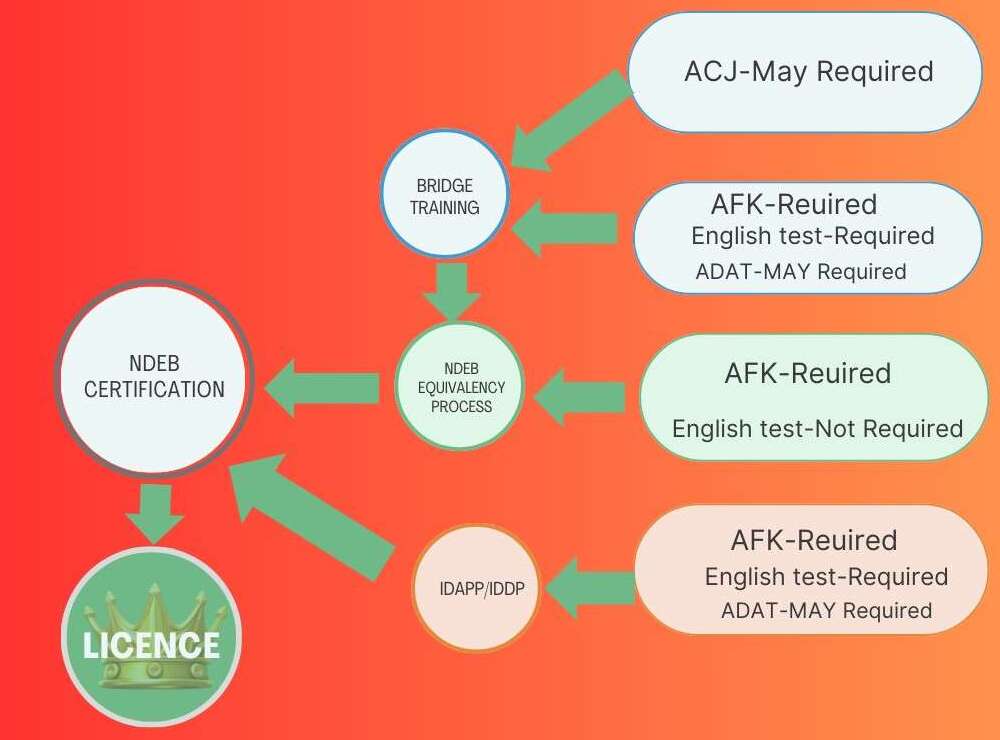
The NDEB Equivalency Process is not the only route available to eligible graduates of non-accredited dental programs.
Some internationally trained dentists may choose to pursue an accredited qualifying or degree-completion program at a Canadian dental faculty.
These programs provide additional dental education and clinical training. Graduates who meet the applicable requirements can become eligible for the NDEB Certification Process.
Certain university programs may consider AFK results as part of their admissions requirements, but individual institutions establish their own criteria.
Another option for eligible candidates is the accredited Bridge Training to Dental Practice in Canada (BTDPC) program, intended for qualifying graduates who have started the Equivalency Process but have not passed NDECC.
Because admission requirements and eligibility conditions differ, candidates should verify the appropriate route before making educational or financial commitments.
How Should Candidates Prepare for the AFK Within the NDEB Pathway?
AFK preparation is most effective when candidates understand both the examination’s academic requirements and its place in their longer-term professional journey.
Begin by reviewing the official AFK examination specifications and identifying subjects that need additional attention.
A structured study approach can include:
- Foundational review: Revisit biomedical and applied clinical science concepts.
- Active learning: Use independently written practice questions to apply knowledge and identify gaps.
- Targeted revision: Spend more time on subjects where understanding remains weak.
- Exam familiarity: Review official sample resources, examination instructions and time constraints.
- Progress monitoring: Evaluate readiness using consistent practice and revision rather than relying only on hours studied.
Candidates should also monitor the official NDEB examination dates and locations to plan registration and travel appropriately.
For additional educational support, explore DentalHeight’s NDEB preparation guides and AFK learning resources.
Structured preparation can help candidates approach the AFK with clearer priorities while developing a foundation for future clinical examinations.
Frequently Asked Questions About AFK and the NDEB Equivalency Process
Is AFK the first examination in the NDEB Equivalency Process?
Yes. AFK is the first examination in the three-examination Equivalency Process for eligible graduates of non-accredited dental programs. Candidates must have an approved Equivalency Process application before registering.
Can I take ACJ without passing AFK?
No. Under the standard NDEB Equivalency Process sequence, candidates must pass AFK before becoming eligible to register for ACJ.
Does passing AFK allow me to practise dentistry in Canada?
No. Passing AFK alone does not provide national certification or provincial licensure. Candidates must complete the remaining requirements of their applicable professional pathway before obtaining authorization to practise.
Is AFK required for every internationally trained dentist?
Not necessarily. The requirements depend on the accreditation status of the candidate’s dental education and the entry-to-practice pathway they follow. Graduates pursuing accredited qualifying or degree-completion programs may have different requirements.
Can I apply to a Canadian dental degree-completion program after AFK?
Some programs consider AFK results as part of admission eligibility. However, passing AFK does not guarantee acceptance. Applicants must meet each institution’s academic, language and other admission requirements.
What should I do after receiving a passing AFK result?
Review your eligibility for ACJ, check available examination dates, consult the latest official guidelines and begin preparing for case-based clinical judgement questions. Maintain access to your NDEBConnect account for examination registration and updates.
Conclusion: AFK Is an Important First Milestone in Canadian Dental Licensure
Understanding where the AFK fits in the NDEB Equivalency Process helps internationally trained dentists approach the Canadian dental licensure pathway with realistic expectations.
The AFK establishes an essential knowledge-based foundation before candidates move into clinical judgement and clinical competence assessments. Completing the Equivalency Process then leads toward national certification and, subsequently, provincial or territorial licensure.
Each stage has a distinct purpose, and successful preparation begins with understanding those differences.
For candidates starting their equivalency journey, DentalHeight provides educational resources and AFK preparation guidance to support organized learning and informed planning.