Internationally trained dentists in Canada have promising opportunities to build rewarding dental careers. However, obtaining a Canadian dental licence requires understanding the NDEB certification process, dental degree accreditation, credential verification and provincial licensing requirements. Whether you are beginning your AFK preparation or exploring alternative licensing pathways, understanding these requirements can help you plan your journey towards practising dentistry in Canada with greater confidence.
Depending on your educational background, you may qualify for the NDEB Certification Process directly or need to complete the Equivalency Process or an accredited qualifying programme. The journey may involve examinations such as the Assessment of Fundamental Knowledge (AFK), Assessment of Clinical Judgement (ACJ), National Dental Examination of Clinical Competence (NDECC) and Virtual Objective Structured Clinical Examination (Virtual OSCE).
This guide explains the available dental licensing pathways, examination requirements, application procedures and career opportunities to help you plan your professional journey in Canada.
Dental Licensing Requirements for Internationally Trained Dentists in Canada

Dentistry is a regulated profession in Canada. Having a dental degree or professional licence from another country does not automatically allow you to practise independently in Canada.
To become a licensed dentist, candidates must meet the applicable National Dental Examining Board of Canada (NDEB) certification requirements and obtain registration from the dental regulatory authority in their chosen province or territory.
The NDEB manages national dental certification and assessment pathways, while provincial and territorial regulators oversee professional registration and licensing.
Before beginning the process, determine whether your dental education programme is recognised by the Commission on Dental Accreditation of Canada (CDAC). Your programme’s accreditation status plays an important role in determining the pathway you must follow.
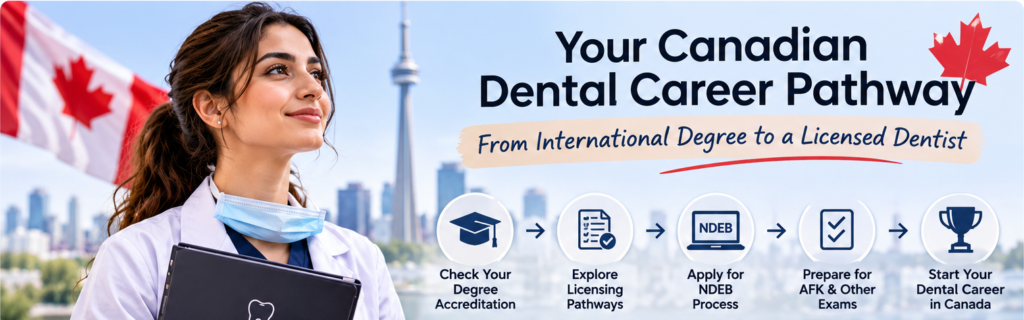
Step 1: Check Your Dental Degree Accreditation Status in Canada
The first step towards becoming a licensed dentist in Canada is checking whether your dental degree programme is recognised by the Commission on Dental Accreditation of Canada (CDAC).
Generally, graduates fall into two categories:
Graduates of accredited dental programmes
Dentists who have graduated from recognised accredited programmes can generally proceed through the NDEB Certification Process. They must meet the applicable examination and documentation requirements before obtaining NDEB certification.
Graduates of non-accredited dental programmes
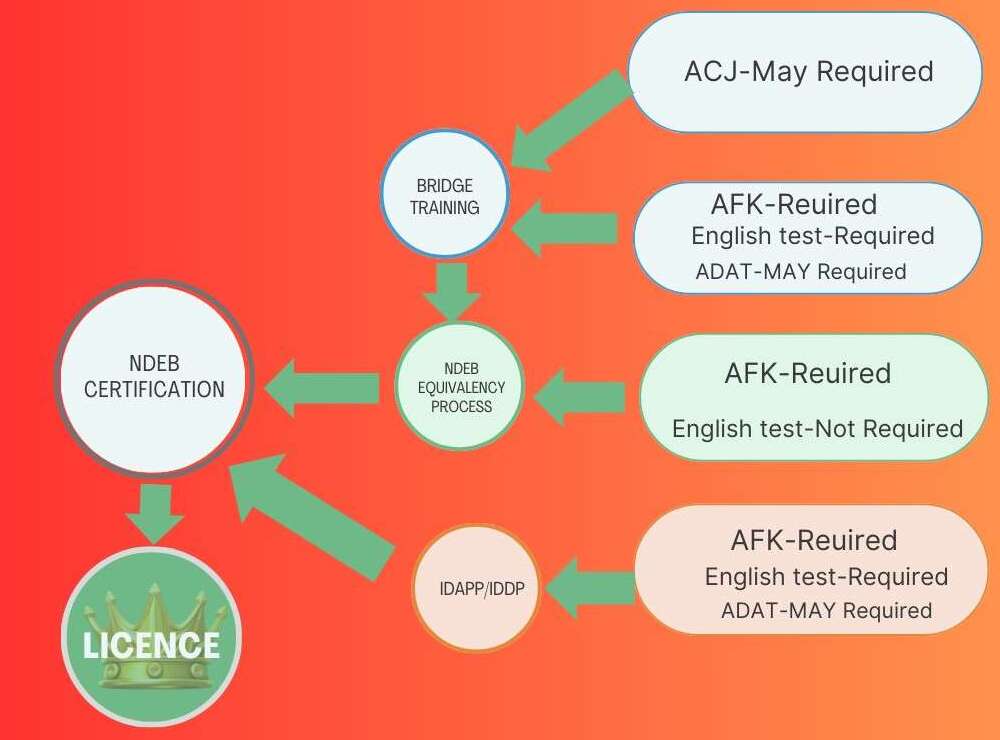
Many internationally educated dentists belong to this category. If your dental programme is not recognised by CDAC, you may need to complete the NDEB Equivalency Process or an accredited qualifying or degree completion programme.
You can verify your educational background through the CDAC accredited dental programme directory.
Remember that accreditation depends on the specific dental programme and applicable recognition agreements, not simply the country where you studied.
Step 2: Explore Dental Licensing Pathways for Foreign-Trained Dentists
Internationally trained dentists with qualifications from non-accredited programmes have several possible routes towards Canadian dental certification.
Understanding these options before investing in examinations or university applications can help you select a pathway that matches your qualifications, budget and professional goals.
1. NDEB Equivalency Process for Internationally Trained Dentists
The NDEB Equivalency Process is an examination-based pathway for eligible graduates of non-accredited dental programmes.
It allows candidates to demonstrate that their dental knowledge and clinical competencies meet Canadian entry-to-practice expectations.
The process includes three major examinations:
- Assessment of Fundamental Knowledge (AFK)
- Assessment of Clinical Judgement (ACJ)
- National Dental Examination of Clinical Competence (NDECC)
After successfully completing the applicable equivalency requirements, candidates can proceed to the NDEB Certification Process. This will provide detailed explanation of the examination sequence and available licensing routes. This whole process will help you in better decisions and also help in planing the exam.
2. Qualifying and Degree Completion Programmes for Foreign-Trained Dentists
Another option is to apply for an accredited qualifying or degree completion programme offered by a Canadian faculty of dentistry.
These programmes are designed to help internationally educated dentists adapt to Canadian academic, clinical and professional standards.
Upon successful completion of an eligible programme, graduates can proceed to the NDEB Certification Process without completing the Equivalency Process examinations.
Some Canadian universities also offer specialised opportunities for internationally educated dentists.
For example, the University of Toronto offers the International Dentist Advanced Placement Program (IDAPP), which allows eligible international graduates to enter its Doctor of Dental Surgery (DDS) programme through an advanced placement route.
The university also offers the Dental Specialty Assessment and Training Program (DSATP) for eligible internationally trained dental specialists.
Admission requirements, programme duration and available places vary. Candidates should check the University of Toronto’s international dentist programmes for current information.
3. Bridge Training to Dental Practice in Canada (BTDPC)
The Bridge Training to Dental Practice in Canada (BTDPC) programme provides another potential pathway for eligible internationally educated dentists.
It is designed for candidates who have already started the NDEB Equivalency Process but have not yet passed the NDECC.
The programme is being developed and pilot-tested at selected Canadian institutions, including the University of Alberta, Dalhousie University and Université Laval.
Importantly, the NDEB identifies specific eligibility requirements, including Canadian citizenship or permanent residency by the application deadline and graduation from an eligible dental programme.
Eligible candidates who successfully complete an accredited bridge programme can apply for the NDEB Certification Process without completing the NDECC, subject to the applicable requirements.
Step 3: How to Apply for the NDEB Equivalency Process
If you decide to follow the examination-based pathway, you must first complete the NDEB application and credential verification requirements.
Start by reviewing the official application instructions and preparing the necessary academic and identification documents.
Your application may require:
- Dental degree certificate or diploma.
- Official academic transcripts.
- Identity documents.
- Additional educational records requested by the NDEB.
- Supporting documentation required for credential verification.
After preparing your documents, create an online profile through NDEBConnect and follow the application instructions.
The NDEB reviews submitted credentials to determine eligibility for the Equivalency Process. Ensure that your documents meet the official requirements and respond promptly if additional information is requested.
It is also important to distinguish professional licensing from immigration requirements. NDEB examination eligibility, provincial registration and Canadian immigration or work authorisation are separate matters. Check the relevant official requirements for your circumstances.
Step 4: Understand the NDEB Examinations and AFK Preparation Requirements
The NDEB examinations assess different areas of dental knowledge, clinical judgement and professional competence.
Understanding the examination sequence can help you organise your preparation and avoid unnecessary delays.
Assessment of Fundamental Knowledge (AFK)
The Assessment of Fundamental Knowledge (AFK) is the first examination in the NDEB Equivalency Process.
It evaluates candidates’ understanding of biomedical sciences and applied clinical sciences, which form the foundation of safe dental practice.
According to the NDEB, the AFK examination includes:
- 200 single-answer multiple-choice questions.
- Two examination parts.
- Two hours allocated to each part.
- A test-equated, rescaled passing score of 75 or higher.
- A maximum of three attempts.
The AFK requires more than memorising dental concepts. Candidates must understand foundational subjects, apply scientific knowledge and interpret clinical information accurately.
An effective preparation strategy should include:
- Reviewing foundational dental and biomedical sciences.
- Creating a realistic study timetable.
- Identifying weak subjects and prioritising them.
- Practising original multiple-choice questions.
- Reviewing explanations to understand why answers are correct or incorrect.
- Taking timed practice assessments to improve examination readiness.
If you are beginning your preparation, AFK preparation resources can help you organise your learning and strengthen your understanding of important dental subjects.
You can also follow a structured 30-day AFK study timetable for working dentists to balance revision, practice and other professional commitments.
For the official examination format, scoring criteria and registration information, consult the NDEB AFK examination guidelines.
Assessment of Clinical Judgement (ACJ)
After passing the AFK, eligible candidates can progress to the Assessment of Clinical Judgement (ACJ).
This examination evaluates a candidate’s ability to apply dental knowledge to clinical situations and make appropriate professional decisions.
Its assessment areas include:
- Clinical diagnosis.
- Treatment planning.
- Clinical decision-making.
- Oral radiology.
- Radiographic interpretation.
Preparing for the ACJ requires a strong understanding of clinical scenarios rather than relying exclusively on memorisation.
Candidates should practise interpreting patient information, identifying dental conditions and selecting appropriate treatment approaches.
The NDEB provides the latest examination requirements and assessment information through its official ACJ examination page.
National Dental Examination of Clinical Competence (NDECC)
The National Dental Examination of Clinical Competence (NDECC) assesses clinical competence within the Equivalency Process.
It evaluates whether candidates can demonstrate the practical skills and professional judgement expected of entry-level dentists in Canada.
The assessment includes clinical performance requirements using simulated patients and situational judgement scenarios.
Candidates should carefully review the current NDEB examination protocol to understand the assessment format, registration requirements and performance expectations.
Step 5: Complete the NDEB Certification Process
Completing the Equivalency Process is an important milestone, but candidates must still meet the applicable NDEB certification requirements.
The next stage involves the NDEB Virtual Objective Structured Clinical Examination (Virtual OSCE).
The Virtual OSCE assesses professional knowledge, clinical reasoning, problem-solving and critical decision-making skills required for entry-level dental practice in Canada.
Candidates who successfully complete the applicable certification requirements and provide the required graduation documentation can obtain NDEB certification.
However, it is important to understand that NDEB certification and provincial dental licensure are not the same.
Certification establishes that you have met the national examination requirements. You must still apply to the relevant provincial or territorial regulatory authority before practising as a dentist.
Step 6: Apply for Provincial or Territorial Dental Licensure
Once you obtain NDEB certification, your next step is to apply to the dental regulatory authority in the province or territory where you intend to practise.
Each jurisdiction establishes its own registration requirements. These may include:
- Proof of NDEB certification.
- Dental degree and identity documentation.
- Evidence of language proficiency.
- Jurisprudence examinations.
- Professional conduct and disciplinary history information.
- CPR certification.
- Registration and licensing fees.
Additional requirements may apply depending on the province and your professional background.
Step 7: Explore Dental Career Opportunities While Completing Your Licensing Requirements
Obtaining a Canadian dental licence can take considerable time, particularly for candidates who must complete multiple examinations or additional academic training.
During this period, some internationally trained dentists explore other professional opportunities related to their education and experience.
Depending on local regulations, qualifications and employer requirements, possible options may include:
- Dental administration.
- Dental practice coordination.
- Dental research.
- Academic and educational support.
- Eligible dental assisting positions.
However, these roles have different qualification and regulatory requirements.
Dental hygiene and dental technology are separate professions in many Canadian jurisdictions. Holding an international dental degree does not automatically qualify someone to practise as a dental hygienist or dental technologist.
Before accepting a position, check the relevant provincial regulations and confirm whether your qualifications meet the requirements.
How Long Does It Take for Internationally Trained Dentists to Get Licensed in Canada?
There is no fixed timeline for every internationally trained dentist.
The time required to obtain a Canadian dental licence depends on several factors, including:
- Credential verification and application processing.
- AFK and ACJ preparation.
- Availability of examination dates.
- Examination results and possible retakes.
- NDECC preparation and completion.
- NDEB certification requirements.
- Provincial or territorial registration procedures.
Candidates choosing qualifying or degree completion programmes may also have to consider university admission schedules and programme duration.
A realistic preparation strategy should account for both examination requirements and administrative processing times.
Checking the latest NDEB examination dates and locations can help you plan your next steps and organise your preparation schedule.
Your Next Steps Towards a Canadian Dental Career
Building a dental career in Canada as an internationally trained dentist requires a clear understanding of accreditation, examinations and professional licensing requirements.
Begin by checking whether your dental programme is recognised by CDAC. Once you understand your eligibility, compare the NDEB Equivalency Process, qualifying programmes and other available pathways.
If you choose the examination-based route, organise your academic documents, understand the AFK, ACJ and NDECC requirements, and develop a structured preparation plan.
Consistent learning and effective examination preparation can help you approach each stage with greater confidence.
DentalHeight provides educational resources, dental subject learning and AFK preparation guidance to support internationally trained dentists throughout their learning journey.
Start with the right information, prepare strategically and take informed steps towards your Canadian dental career.
Frequently Asked Questions
Can internationally trained dentists practise in Canada?
Yes. Internationally trained dentists can practise in Canada after meeting the applicable NDEB certification requirements and obtaining registration from the dental regulatory authority in their chosen province or territory.
What is the NDEB Equivalency Process?
The NDEB Equivalency Process is an examination-based pathway for eligible graduates of non-accredited dental programmes. It includes the AFK, ACJ and NDECC. Successful completion allows candidates to proceed to the NDEB Certification Process.
Is the AFK the first examination for foreign-trained dentists?
Yes. The Assessment of Fundamental Knowledge (AFK) is the first examination in the NDEB Equivalency Process for eligible graduates of non-accredited dental programmes.
Does passing the AFK allow me to practise dentistry in Canada?
No. Passing the AFK alone does not provide NDEB certification or a provincial dental licence. Candidates must complete the remaining applicable examination and certification requirements before applying for provincial registration.
Do I need permanent residency to apply for the NDEB Equivalency Process?
Canadian citizenship or permanent residency is not a general prerequisite for applying to the NDEB Equivalency Process. However, immigration and work authorisation requirements are separate. Certain university programmes and bridge training opportunities may have specific citizenship or residency eligibility conditions.
What happens after NDEB certification?
After receiving NDEB certification, you must apply to the dental regulatory authority in the province or territory where you intend to practise. You must meet its additional registration, documentation and professional requirements before receiving permission to practise.
Can internationally trained dentists study in Canadian dental schools?
Yes. Eligible international graduates can apply to qualifying or degree completion programmes offered by Canadian dental faculties. Admission requirements vary by university and may include examination results, academic records, language proficiency and other assessments.
Is IELTS required for the AFK examination?
The NDEB’s AFK examination requirements do not list IELTS as an examination registration requirement. However, language proficiency may be required by individual universities and provincial dental regulators. Candidates should verify the requirements of their intended programme or licensing authority.