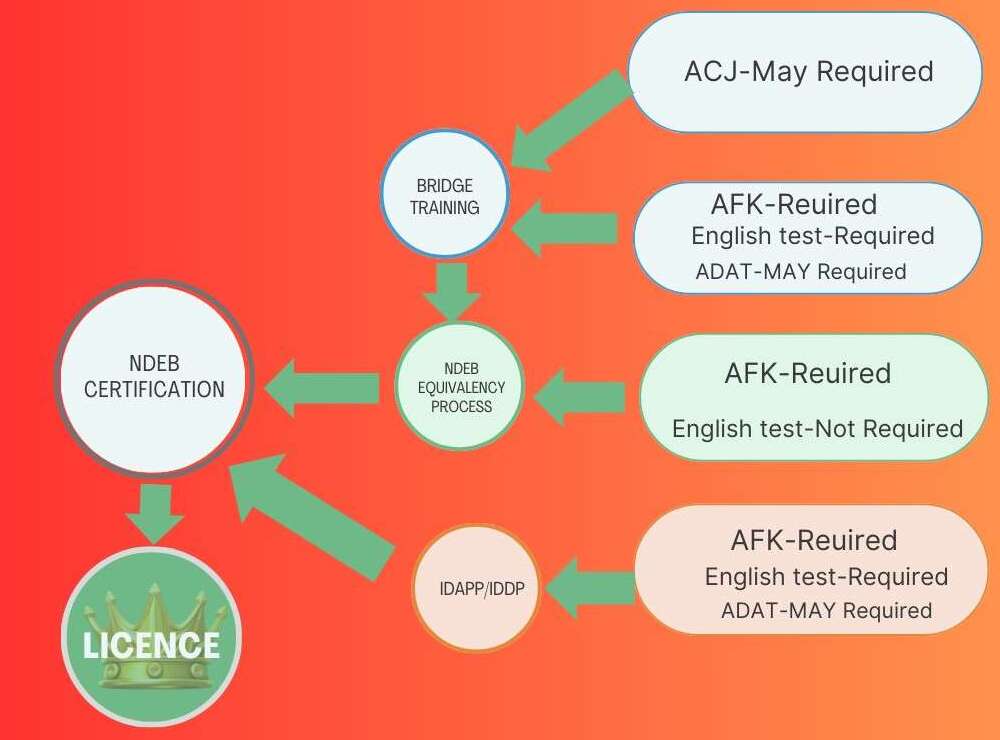
Preparing for the Assessment of Fundamental Knowledge (AFK) is a major step for internationally trained dentists pursuing the NDEB Equivalency Process in Canada. With a broad range of biomedical and dental knowledge to review, candidates often face one difficult question: How can you cover the material, retain important concepts, and prepare effectively within a limited amount of time? A well-structured active recall plan for AFK preparation can help candidates organize their study sessions, strengthen knowledge retention, and identify areas that need further revision.
An active recall study plan helps you move beyond passive revision. It gives every study session a purpose, makes knowledge gaps easier to identify, and allows you to revisit difficult concepts before you forget them.
This guide explains how to build a realistic 12- or 16-week AFK study plan, organize the major knowledge areas, use active recall techniques for dental subjects, and evaluate your preparation through regular practice.
Understanding the AFK Examination Before You Start
Before developing a study schedule, understand what the AFK assesses and how the examination is structured. Your preparation should reflect the examination’s actual requirements rather than assumptions based on general dental school revision.
The Assessment of Fundamental Knowledge is the first examination in the NDEB Equivalency Process for eligible graduates of non-accredited dental programmes. It assesses candidates’ knowledge of two broad areas:
- Biomedical sciences: Fundamental scientific knowledge relevant to dentistry and the human body.
- Applied clinical sciences: Knowledge used to understand dental conditions, clinical principles, and patient care.
AFK Examination Format
According to the NDEB, the AFK consists of:
| Examination detail | Official information |
|---|---|
| Total questions | 200 |
| Question format | Single-answer multiple-choice questions |
| Examination structure | Two parts |
| Time allowed | Two hours per part |
| Delivery | Electronic at Prometric centres or booklet format at selected sites |
| Passing standard | Test-equated, re-scaled score of 75 or higher |
| Maximum attempts | Three |
Each question is worth one point, with zero being the lowest score. However, the reported passing score is not a direct percentage of correct answers. The NDEB uses a test-equating procedure to maintain a consistent passing standard across different examination versions.
Candidates should also read the current AFK Protocol carefully. It contains important examination information and instructions that should guide their preparation.
What Knowledge Areas Should You Include in Your AFK Study Plan?
The NDEB identifies biomedical science and applied clinical science as the two broad areas assessed. Candidates can use the following subject groups to organize their revision and make sure their preparation covers the interconnected knowledge required in dentistry.
Biomedical science areas
- Anatomy, including head and neck anatomy
- Physiology and human body systems
- Biochemistry and metabolism
- Microbiology and infection-related concepts
- General and systemic pathology
- Pharmacology and drug mechanisms
- Dental biomaterials and relevant biological principles
Applied clinical science areas
- Restorative dentistry and operative principles
- Prosthodontics and dental rehabilitation
- Endodontics and pulpal conditions
- Periodontics and periodontal diseases
- Oral medicine and oral pathology
- Oral radiology and interpretation principles
- Oral surgery and dental emergencies
- Paediatric dentistry and preventive care
- Orthodontics and occlusion
- Infection prevention, ethics, and patient management
This is a practical study-organizing framework, not a reproduced official NDEB blueprint or a statement of subject-wise question percentages. Candidates should consult the current NDEB examination resources for official requirements and updates.
Why You Need a Structured Study Plan for AFK Preparation
A broad syllabus can quickly become difficult to manage without a clear timeline. Candidates may spend too much time on familiar subjects, postpone challenging topics, or leave practice questions until the final weeks.
A structured plan helps distribute the workload and makes preparation easier to evaluate.
Avoiding Study Fatigue
AFK preparation requires consistency, especially for candidates balancing work, family, and other responsibilities. Long study hours without breaks can affect concentration and motivation.
To avoid burnout:
- Set realistic daily study goals.
- Take short breaks between sessions.
- Schedule regular revision.
- Track weekly progress.
- Make time for rest.
Break large chapters into smaller topics and focus on understanding one concept at a time.
Making the Most of Limited Preparation Time
Whether you have 12 or 16 weeks, a structured plan helps you use your study time effectively.
Focus on:
- Covering biomedical and clinical sciences.
- Prioritizing difficult topics.
- Starting MCQ practice early.
- Scheduling regular revision.
- Reserving final weeks for mock tests.
The goal is to study strategically, retain knowledge, and maintain consistent progress.
Understanding Active Recall for AFK Preparation
Active recall involves retrieving information from memory without looking at your notes or textbooks. For example, after studying cranial nerves, try recalling their names, functions, and clinical associations before checking your notes.
Unlike passive learning methods such as re-reading and highlighting, active recall requires you to test your understanding independently. It can be applied to:
- Drug classifications, mechanisms, and adverse effects.
- Anatomical structures and their functions.
- Disease processes and diagnostic features.
- Clinical presentations and treatment principles.
For better retention, combine active recall with spaced revision. Research in health professions education supports both techniques as effective learning strategies. This makes them useful tools for organising your AFK preparation.
Choosing Your AFK Preparation Timeline
Your study timeline should depend on your current knowledge, available study hours, and exam date. Two practical options are:
| Factor | 12-week plan | 16-week plan |
|---|---|---|
| Suitable for | Stronger academic foundation | More time needed for revision |
| Daily study time | 4–5 hours | 3–4 hours |
| Study pace | Intensive | Gradual |
| Revision | Integrated throughout | More time for revision |
| MCQ practice | Starts early | Increases gradually |
These are suggested schedules, not official NDEB requirements.
How to choose: Assess your subject knowledge, weekly availability, learning pace, and familiarity with MCQs before selecting a timeline. Adjust the schedule to allow enough time for learning, practice, and revision.
Start with a Diagnostic Assessment
Before beginning your full study schedule, complete a diagnostic assessment to understand your starting point.
The NDEB provides a web-based self-assessment consisting of 100 multiple-choice questions. It is designed to help candidates gauge their ability to complete the AFK. The result provides a tally of correct responses, but it does not guarantee that a candidate will achieve the required passing score in the actual examination.
You can use this assessment as an initial reference point and supplement it with topic-based practice.
After completing a diagnostic assessment:
- Review every incorrect answer.
- Identify the subject or concept associated with each mistake.
- Separate knowledge gaps from careless errors or misunderstood questions.
- Create a list of topics that require additional study.
- Use this list to prioritize your first few weeks.
Do not use one diagnostic score to judge your overall potential. Its main purpose is to help you make informed decisions about your preparation.
Applying Active Recall Throughout AFK Preparation
Your active recall strategy should evolve as you progress through different subjects. Instead of following fixed daily study hours, adjust your recall activities according to the complexity of the material and your understanding.
- Foundation stage: Recall anatomical structures, physiological processes, biochemical concepts, and basic pathology without consulting notes.
- Clinical learning stage: Compare dental conditions, diagnostic features, treatment principles, and pharmacological concepts using questions and clinical scenarios.
- Consolidation stage: Use mixed-subject questions, blank-page recall, and flashcards to identify knowledge gaps across different subjects.
- Final revision stage: Revisit difficult concepts, practise timed MCQs, and test your ability to retrieve and apply knowledge without relying on study materials.
The key is to make retrieval practice a consistent part of learning, rather than restricting it to the final weeks.
Active Recall Techniques for Important Dental Subjects
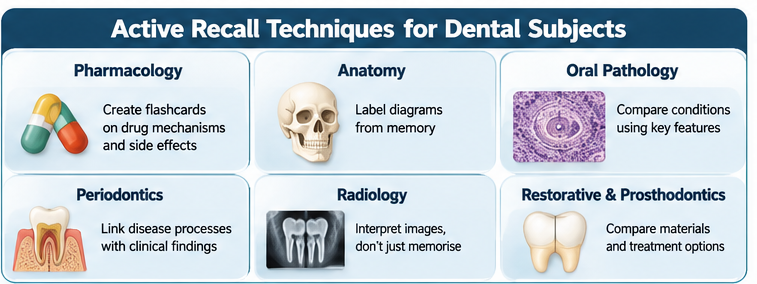
Active recall can be adapted to different types of dental and biomedical information. The most useful technique depends on whether you are learning definitions, mechanisms, anatomical structures, clinical differences, or diagnostic concepts.
Pharmacology: Recall Drug Mechanisms and Clinical Applications
Pharmacology requires more than memorizing drug names. Candidates should understand drug actions, classifications, indications, contraindications, interactions, and adverse effects.
Create flashcards around individual concepts.
For example:
- What is the mechanism of action of a particular drug?
- Which receptor or pathway does it affect?
- What are its important adverse effects?
- Which clinical factors may influence its use?
After studying a drug class, create a comparison table from memory. Include the relevant drug groups, mechanisms, and distinguishing features.
This makes it easier to identify differences between similar medications.
Anatomy: Use Diagram-Based Recall
Anatomy contains numerous structures, relationships, and functions that can be difficult to retain through reading alone.
Try this method:
- Study an anatomical diagram carefully.
- Hide the labels.
- Reproduce the diagram or label a blank version.
- Recall the functions and relationships of the structures.
- Check your answers and repeat the exercise for difficult areas.
Head and neck anatomy is particularly suitable for diagram-based revision because it involves interconnected structures, nerves, muscles, and anatomical spaces.
Oral Pathology: Practise Comparing Conditions
Oral pathology requires you to understand disease characteristics and distinguish between conditions with similar presentations.
Create comparison tables covering:
- Clinical appearance.
- Common location.
- Relevant patient history.
- Associated features.
- Important diagnostic considerations.
After reviewing a group of conditions, hide the comparison table and try to identify each condition from its distinguishing features.
Where appropriate, practise interpreting relevant clinical images as part of your revision.
Periodontics: Connect Disease Processes with Clinical Findings
When studying periodontal conditions, focus on the relationship between disease processes, clinical findings, and treatment principles.
Use questions such as:
- What changes occur in periodontal tissues?
- Which clinical findings are associated with the condition?
- How do different periodontal conditions differ?
- What principles guide periodontal assessment and management?
This approach encourages you to connect biological mechanisms with clinical knowledge.
Radiology: Practise Interpretation Rather Than Memorizing Images
Radiology revision should involve understanding image features and the principles behind their interpretation.
After studying a radiographic concept, practise identifying relevant structures and describing what you observe. Where appropriate, compare normal anatomical appearances with common abnormalities.
Do not rely only on memorizing individual images. Focus on the reasoning required to interpret the findings.
Restorative Dentistry and Prosthodontics: Use Concept Comparisons
These areas involve materials, procedures, indications, limitations, and treatment principles.
Create comparison questions around:
- Differences between restorative materials.
- Material properties and clinical applications.
- Fixed and removable prosthodontic principles.
- Factors affecting treatment selection.
- Important clinical considerations.
Try to explain why a particular material or treatment approach is appropriate rather than memorizing a list without understanding its purpose.
How to Practise AFK-Style MCQs Effectively
Multiple-choice questions should be part of your preparation from the beginning, not something reserved for the final weeks.
The AFK uses single-answer multiple-choice questions. Candidates must select the most appropriate answer from the available options.
Read the Question Before Looking at the Options
Read the question carefully and identify what it is asking. Pay attention to clinical details, important qualifiers, and the specific concept being tested.
For example, a question may ask about a drug’s mechanism, an anatomical relationship, or the most appropriate interpretation of a clinical finding.
Understanding the question first can help you avoid choosing an option simply because it contains a familiar term.
Eliminate Incorrect Options Systematically
When you are unsure of the answer:
- Identify the concept being tested.
- Remove options that clearly contradict the underlying principle.
- Compare the remaining choices.
- Select the single best answer based on the information provided.
Avoid changing an answer repeatedly without a clear reason. If you are uncertain, mark the question for review during practice and examine the explanation afterward.
Review Every Incorrect Answer
The most important part of MCQ practice is not the number of questions completed. It is what you learn from the questions you get wrong.
For every incorrect answer, ask:
- Did I lack the necessary knowledge?
- Did I confuse two similar concepts?
- Did I misunderstand the question?
- Did I overlook an important clinical detail?
- Was my answer based on guessing rather than understanding?
Record the reason for the mistake. This will help you identify patterns and decide what to revise next.
Building Examination Stamina with Timed Mock Tests
The AFK requires candidates to answer 200 questions across two parts, with two hours allocated to each part.
That means candidates should practise not only retrieving information but also maintaining concentration and managing time across extended question sessions.
Start with Short Timed Sessions
If you are new to timed practice, begin with smaller sets of questions.
For example, attempt 20 questions in a focused session and evaluate how accurately and efficiently you answer them.
Gradually increase the number of questions as you become more comfortable with the format.
Progress to Full-Length Practice
As your examination date approaches, include longer practice sessions that reflect the AFK’s two-part structure.
A full-length practice session can help you evaluate:
- Your ability to maintain concentration.
- Your time management across both parts.
- Your performance across different knowledge areas.
- Your tendency to rush or overthink questions.
- Your ability to recover after encountering difficult questions.
The official format provides two hours for each part of 100 questions. This averages approximately 1.2 minutes per question, although actual time spent will vary depending on question complexity.
Analyse Your Mock Test Results
Do not evaluate a mock examination using only its final score.
Review your performance by subject and mistake type. Identify whether your errors are caused by weak knowledge, confusion between concepts, or difficulty interpreting questions.
A candidate who consistently makes the same mistakes in pharmacology may benefit more from targeted revision than from completing another large mixed question set immediately.
Mock test results are useful indicators of progress, but they do not guarantee the outcome of the official examination.
Common AFK Study Planning Mistakes to Avoid
Even a well-designed study plan can become ineffective if you follow unproductive study habits.
1. Spending Too Much Time on One Subject
Candidates sometimes spend several weeks on a familiar or particularly interesting subject while postponing other areas.
What to do instead: Divide your study time across the broader knowledge areas. Allocate additional revision time to difficult subjects without neglecting the rest of your preparation.
2. Delaying MCQ Practice Until the Final Weeks
Waiting until the end to attempt questions can leave you unfamiliar with the examination format and unsure about your knowledge gaps.
What to do instead: Introduce topic-based questions from the beginning and gradually move towards mixed and timed practice.
3. Memorizing Without Understanding
Memorizing drug names, disease classifications, or anatomical facts without understanding their relationships can make it difficult to apply knowledge to unfamiliar questions.
What to do instead: Ask yourself why a process occurs, how related concepts differ, and what clinical significance the information has.
4. Ignoring Previous Mistakes
Completing more questions does not automatically improve your understanding if you never review incorrect answers.
What to do instead: Maintain an error log and revisit recurring mistakes through active recall.
5. Creating an Unrealistic Daily Schedule
Setting targets that require excessive study hours can lead to missed sessions, frustration, and burnout.
What to do instead: Build a schedule around your actual availability. A manageable routine that you can maintain is more useful than an ambitious plan that you abandon after a few days.
6. Neglecting Cumulative Revision
Studying each topic once and moving on can result in forgetting previously covered information.
What to do instead: Use spaced repetition and reserve time every week to revisit earlier topics.
Tools and Resources to Support Your AFK Study Plan
Use simple tools to organize your preparation and make revision more effective.
- Digital planners: Track weekly goals, completed topics, revision dates, and MCQ performance using a spreadsheet or study planner.
- Flashcards and spaced-repetition tools: Practise recalling pharmacology mechanisms, anatomical structures, pathological features, and dental concepts. Keep each card focused on one idea.
- Question banks: Use relevant practice questions to test your understanding, identify knowledge gaps, and review incorrect answers.
- Official NDEB resources: Consult the NDEB AFK examination page for examination information and the official self-assessment. Check the NDEB resources page for current protocols and updates.
Remember, study tools should support conceptual understanding and active recall, not replace them.
How DentalHeight Academy Can Support Your AFK Preparation
Preparing for the AFK involves more than collecting study materials and completing practice questions. Candidates also need a clear preparation strategy, a way to identify knowledge gaps, and consistent guidance as they progress through different subjects.
A structured learning approach can help candidates understand difficult concepts, organize their revision, and make better use of their available preparation time.
For candidates seeking additional academic guidance, personalized support can be useful in areas such as:
- Identifying subjects that require additional attention.
- Organizing a realistic study timeline.
- Clarifying difficult biomedical and clinical concepts.
- Reviewing practice questions and understanding mistakes.
- Monitoring progress and adjusting revision priorities.
Before choosing any preparation programme, understand what support it provides and whether it matches your learning needs, examination timeline, and current knowledge level.
FAQs About Active Recall and AFK Study Planning
1. How many months should I prepare for the AFK?
The preparation period depends on your existing knowledge, study availability, and familiarity with the examination format. A 12- or 16-week plan can provide a useful structure, but some candidates may need more time. Begin with a diagnostic assessment and choose a timeline that allows sufficient learning, practice, and revision.
2. Is active recall better than reading textbooks for AFK preparation?
Active recall and textbook reading serve different purposes. Reading helps you understand new information, while active recall tests whether you can retrieve it independently. Combining both methods is more useful than relying exclusively on either one.
3. How many MCQs should I practise every day?
There is no official daily MCQ requirement for AFK preparation. Start with a manageable number of topic-based questions and increase the amount as your understanding improves. Focus on reviewing explanations and correcting mistakes rather than completing questions simply to reach a numerical target.
4. Should I study biomedical sciences and clinical sciences separately?
You can initially organize them into separate study blocks to build a clear foundation. However, you should also practise connecting related concepts. For example, understanding pharmacology, anatomy, and pathology can help you approach applied clinical questions more effectively.
5. How often should I revise a topic using active recall?
A practical starting schedule is to review a topic on the same day, the following day, three days later, one week later, and two weeks later. Adjust these intervals according to your ability to recall the material. Difficult topics may require more frequent revision.
6. How should working professionals prepare for the AFK?
Working professionals can divide their preparation into shorter daily sessions and use weekends for longer revision or practice tests. Prioritize consistency, realistic targets, and regular recall rather than trying to match the study hours of full-time candidates.
7. Does a high mock test score guarantee an AFK pass?
No. Practice scores can help you evaluate your progress, but they cannot guarantee the result of the official examination. The NDEB uses a test-equated, re-scaled scoring procedure, and the result depends on performance against the established passing standard.
8. What should I do if I keep forgetting previously studied topics?
Return to the underlying concepts and identify why you are struggling to remember them. Use active recall, spaced repetition, comparison tables, and practice questions. Schedule another revision session sooner and check whether you can retrieve the information without looking at your notes.
Conclusion: Prepare with a Plan, Practise with Purpose
AFK preparation requires a balanced approach to learning, revision, and examination practice. Covering a large amount of material is not enough if you cannot retrieve and apply that knowledge when answering questions.
Start by understanding the examination requirements, organizing the biomedical and applied clinical knowledge areas, and choosing a realistic preparation timeline. Build daily study sessions around learning, active recall, MCQ practice, and spaced revision.
As your examination date approaches, shift your focus towards mixed questions, timed practice, and correcting recurring knowledge gaps. Track your progress, adjust your schedule when necessary, and maintain a routine that you can follow consistently.